Well, sort of. As the story goes at the Buena Vista, the cafe’s owner Jack Koeppler in 1952, returned from Ireland and challenged travel writer Stanton Delaplane to re-create the “Irish Coffee” that he had fallen in love with at the Shannon Airport in Ireland. Even traveling back to Shannon to taste the specimin himself, Delaplane concocted the recipe that has now turned the Buena Vista into an essential stop for this iconic beverage. It’s so iconic that the six ounce goblets chosen by Delaplane for the Irish Coffee are now known as Irish Coffee goblets.
The concept is simple: Irish whiskey spiked sweetened coffee with unsweetened whipped cream. The Buena Vista doesn’t skimp on the whiskey, putting just enough into the coffee to be boozy without tasting like a straight shot. Only the whipped cream disappointed me a bit, being thin and flavorless, adding nothing to the drink.
The Buena Vista is smack in the middle of tourism central, along the bayfront, across the street from the cable car turn-around, and just feet away from Fisherman’s Wharf and Pier 39. I had never been here before this week, though I once or twice have braved the crowds and ridden the cable car by the Buena Vista. O.K., I’ve had chicken tenders as a kid waiting for a delayed flight at the Buena Vista in San Francisco Airport’s Terminal Three. But, that doesn’t count.
It’s a touristy location for certain and the assembly line nature of the bar with dozens of goblets lining the bar ready for the next customer seems catered to tourists in awe of just being there. Locals love the fact that the place stays open until 2 am each night. You may fall immediately asleep or never fall asleep all night after one of the Irish Coffees.
Would I go again? It’s not a bad cocktail once you get past the cream. Is it truly San Francisco? It’s San Francisco like the cable cars are San Francisco. They are a part of the folk lore of the city, but not something locals actually use.
The two main events of May happen to coincide this year, tomorrow on the first day of Saturday. hot brown sandwiches, tacos, margaritas, and mint julips all in one day– or better yet, a hot brown taco and a mint bourbon-rita?
We’re always on the lookout for not well known, unique types of wines. How about the reds from the Valpolicella region of Italy? The amaro sounds fascinating.
What does one’s imagination create when pondering the concept of la dolce vita? Lying on the beach? Dressed to the nines for a night at the opera? Sophia Loren?
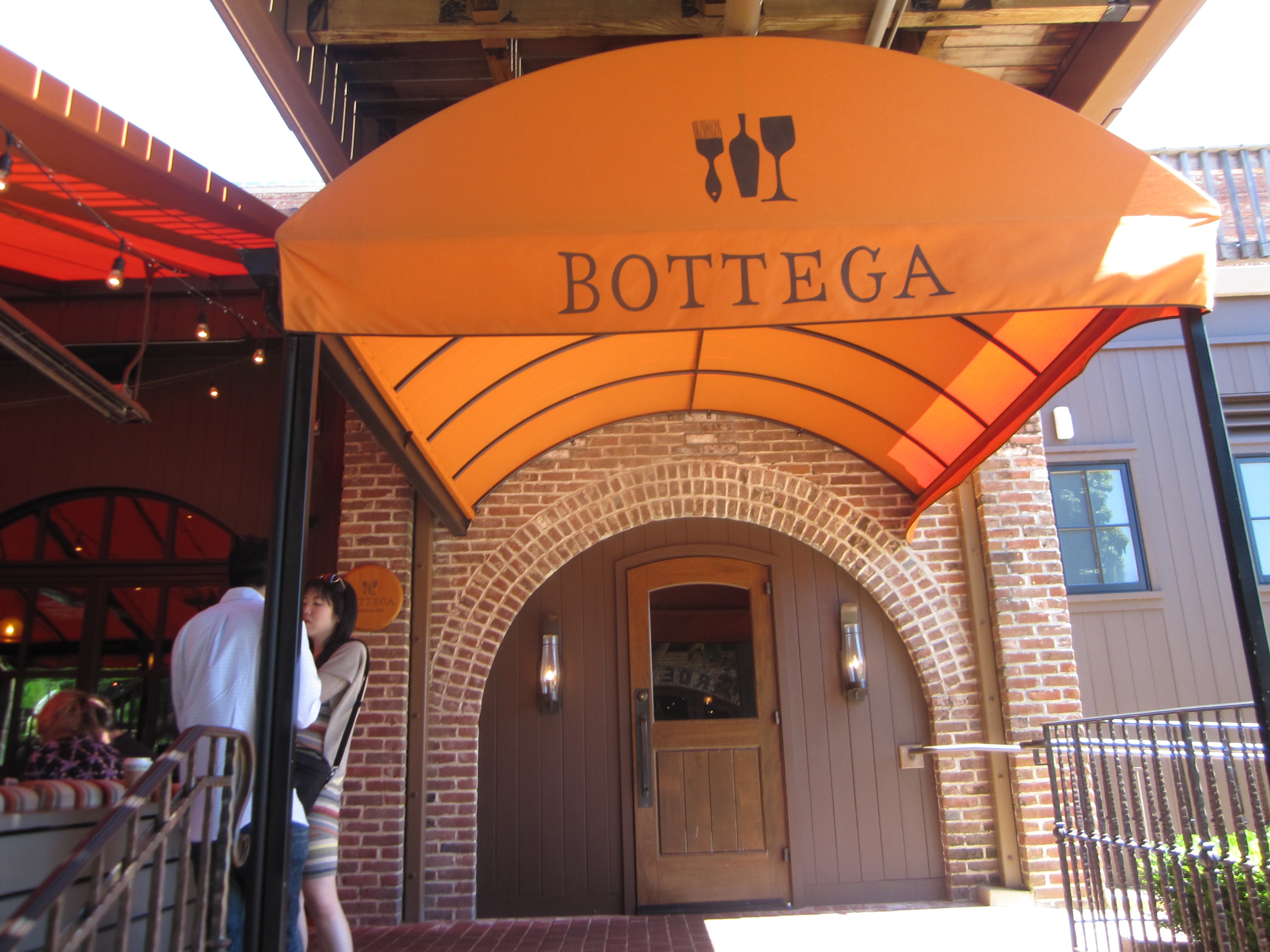
La dolce vita is all I could think about sipping the Chiarello Family’s exquisite Chiara Bianco Ribolla Gialla, contemplating the revelation that is Bottega’s polenta under glass. Served in a canning jar with the lid open (so the polenta really is more “inside” glass), the polenta arrives heated to a lusciously soft consistency that no polenta has ever seen, and is so robust in flavor than any other polenta you’ve likely encountered. We’re talking about polenta here, the side dish everyone dreads to see with that tempting fish or steak you were originally planning to order. Usually polenta, or corn meal, or also considered baby food, is a waste of plate space. It’s a plate and stomach filler. Not here whatsoever.
Michael Chiarello and his executive chef Robert Hohmann elevate the humble polenta to unseen before gastronomic heights. Caramelized mushrooms relax atop the polenta until your server instructs you to spoon both the polenta and mushroom together when serving onto your plate. The polenta’s creaminess is as majestic as Jöel Robuchon’s mashed potatoes, with far less actual cream involved. After serving, you pour from the miniature pitcher of balsamic game sauce, lending an acidic-meaty kick to the sweet earthy mushrooms and that precious polenta. In the hands of a master, a common peasant dish such as polenta can be transformed into a meal centerpiece, where polenta is no longer polenta. It is something far above we could ever have imagined from cornmeal.Continue reading “Restaurants: Bottega, Yountville, CA: Where Tuscany and California Collide”
What’s that you say? A cocktail on tap? It’s bizarre enough to see wine on tap at several bars and restaurants. But, really, cocktails? Cocktails are supposed to be individually made by the mixologists, right? Only the low grade bars have margaritas swirling in a machine I’m pretty sure.
Negroni on Tap
It’s the next step in the evolution of drinks on draught, starting with beer, then wine, and now the new frontier started by Kevin Diedrich, the bar manager at Jasper’s Corner Tap in San Francisco, cocktails on tap. It seems like a natural progression. Cocktails on tap also seem like a natural companion to the recent discovery of barrel aged cocktails, started by Portland’s Clyde Common. Continue reading “Cocktail of the Week: Negroni on Tap, Jasper’s Corner Tap, San Francisco”
Among the many intriguing beers at my sampling at Dogfish Head’s Rehoboth Beach, Delaware pub, the special release Sah’tea stood out. First we thought, a beer that’s flavored like chai tea? Really?
It works. In fact, it really is like a brilliant Belgian beer without the overkill of being too malty tasting. At 9%, this is far from a session beer, yet its homey cardamom, cinnamon, and black tea notes make this a beer you can cuddle with and savor, instead of taking deep breaths between interpreting sips. Sam Malone, Dogfish Head’s brewmaster adores exotic worts and woods and rocks to accent his beer. The wort for Sah’tea is caramelized over hot river rocks. In theory Sah’tea is a take on a 9th century Finnish beer…I’d be shocked if Finland really had such eye-opening brews back then, but you never know.
As recommended by Dogfish Head’s website, a thai curry dish mixing sweet and savory could be a great compliment. I’d say just sit back and enjoy the fascinating notes of Sah’tea. It’s the best tasting tea I’ve ever had.
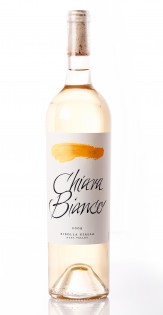
As a prelude to tomorrow’s review of Michael Chiarello’s three year old Yountville, CA restaurant Bottega, this week’s highlight vintage is this 2011 white wine that packs a wallop of flavor, while being easily drinkable and complimentary to all sorts of foods. At first, a beautiful nose of fresh spring time and slightly dew covered grass greets you, followed by a citrus zing that reminded me of a twist in a negroni a bit. There was some nuttiness apparent, vaguely similar to a denser dry sherry.
The cloudy nature of the wine comes because it is crafted in the same manner as a red wine, with lots of skin contact. I find that the structure is incredibly well-rounded because of this, mixing the best of both white wine worlds: top notch chardonnay structure with the fresh awakening of a pristine sauvignon blanc. The young wine is finished for six months in aged French oak barrels. It’s a young wine that is already at its peak, fully balanced between some sweet, some fruit, and some herb-mineral accents.
Chiarello Family Vineyards operates and grows their grapes in St. Helena, a little north up Highway 29 from the Chiarello’s restaurant, Bottega. Only 100 cases of the Chiara Bianco are sold and were just released two weeks ago. The family also makes various cabernet sauvignons and zinfandels, all named after family members. These are bold Italian style wines without the off notes- too much tannin or too much mineral that drag down many Italian wines.
So, what again is this Italian grape? It’s ribolla gialla, a very rare white grape that the Chiarello’s planted with cuttings from the Fruili region in Northeast Italy, a region known for its bold, slightly fruity whites.
It’s a perfect fresh, springtime wine…especially with any dish by Chiarello at Bottega.
After Monday’s announcement of the World’s Top 100 Restaurants according to the U.K.’s Restaurant Magazine survey of 800 international food critics and experts, I thought now would be a great time to wear the trend watch hat and see what is hip and happening right now, along with what will be this time next year. We can see the future clearly inside the bistro…
What’s In?
Modernism
The avant-garde, molecular gastronomy movement did not fade away because El Bulli closed. Foams may be appearing on fewer menus. That doesn’t mean we’re not seeing dehydrated this and powder that, led by Alinea, Noma, Mugaritz, WD-50, et al. Of the dishes that represent the present, there may none more 2012 than the “vegetables in edible soil” at Noma.
Foraging, Pickling, Do It Yourself
It’s the mantra of Noma. It’s the mantra of Brooklyn. Make your own jams. Pickle your own carrots. Forage for some obscure berry in the forest or along the FDR. There is a slight revolt starting against listing every foraging buzz word (Chatham Straight Line Cod with Mary’s Tomatoes, Napa County Wheatberry, and Strawberry Farms Basil…). Today we’re seeing more simple descriptions that don’t care where the fish comes from or even what it’s with. Just see the menu at Eleven Madison Park.
Prix Fixe is In
WD-50 in New York just announced they will be exclusively prix fixe for the first time in the decade old restaurant’s history. In Northern California, Saison and Meadowood have announced that they will be offering 20 something chef’s table prix fixe meals for around $500 each. This goes already with how nearly every restaurant on this list from Mugaritz to Chez Panisse is prix fixe. Doing research for an upcoming visit to Stockholm, Sweden, nearly every one of the city’s top restaurants AND bistros is multi course, prix fixe only, including the three from Stockholm in the Top 50.
Tickets
Pay and plan far in advance for your meal as if it is the opera or a baseball game. Next in Chicago started this, then came Saison, and now it’s going around the world.
We Don’t Need a Table
Considering the number of Michelin stars owned by sushi bars in Japan and seeing Momofuku Ko at 76 and L’Atelier de Joel Robuchon in Paris at 12, there is no problem for diners in general eating at the bar or communal table…the bar is fine, but that communal table is a trend that needs to end.
The Sensory Experience
Heston Blumenthal of The Fat Duck and Dinner, both in the U.K. and Nos. 13 and 9, is attempting to combine holograms with what you’re served. Grant Achatz is exploring music as part of a dish. Daniel Patterson of Coi in San Francisco has for a long time considered smell is a key component of the dining experience.
What’s Next?
Plogue à Champlain (Foie Gras in Maple Syrup) and Boudin Noir at Au Pied de Cochon, Montréal
Foie Gras
What’s that you say? Isn’t foie gras about to be banned in California? Indeed it will be, yet because of the ban foie gras had had a resurgence of enthusiasm for it. Also because of the over top foie gras stuffed foie gras type cuisine presented by popular restaurants Joe Beef and Au Pied de Cochon in Montréal, foie gras is coming back. We’re predicting here California will still be eating foie gras too after July 1st.
Delis
Delis aren’t chopped liver anymore. From the smoked meats at Mile High in Brooklyn (which this week opens a Manhattan outpost) to the new Jewish deli Wise Sons in San Francisco, sandwiches will have a renaissance everywhere soon, starting with the meat that goes into them. Speaking of chopped liver, it’s starting to pop up on menus too. It’s a way for casual, neighborhood bistros to serve pâté, without the formal connotation.
Moroccan Cuisine
With Mourad Lahlou’s ground-breaking vision of modern Moroccan cuisine at his San Francisco restaurant Aziza and his new cookbook, the brilliant sensory experience that is the food of Morocco will soon be the next cuisine chefs attempt to tackle worldwide.
African Cuisine
Along with Morocco’s cuisine, other countries’ cuisines from the across the continent will start being modernized and interpreted. From Ethiopia to Ghana to South Africa to Senegal, we’ll start seeing more of these cuisines. We’re already seeing some of this starting with new visionary places like Radio Africa in San Francisco.
The End of Speakeasies, the Continuation of Mad Men
While having mixologist made cocktails, people do want to see their drink and (usually) their date. In speakeasies you can’t see your own hand. The popularity of Mad Men style sipping in plush booths and seductively dark environs is only rising with the current season being broadcast.
Chicken
Yes, chicken. Every list needs a bold prediction. We’ll get tired of pork jowl and lamb neck and soon appreciate a terrific moist chicken or quail or squab. There are more ways to prepare chicken than roasted on a spit with a sprig of thyme. Just ask Paul Bocuse.
Coffee Roaster-Cafes…Starbucks Will Fade
The third wave for coffee is thriving in west coast cities, Chicago, New York, and even Tokyo…you’ll see it in Paris, London, Moscow, Shanghai, and more very soon. This might be wishful thinking, but this new third wave may start slowly chiseling away at the previous wave, also known as Starbucks.
What is a Meal?
We’re seeing some of it where brunch is dinner, lunch is a whole duck, breakfast is at midnight, or early dinner is a few bar snacks…the whole definition of three square meals a day and three courses at dinner time are certainly fading away.
So, what really is next? That’s what we’re here to cover at Trev’s Bistro. Of course our predictions will be 100%, right?
To close today, what we hope will be next is the end of hunger and the end of obesity. Mark Bittman, one of our greatest and most eloquent voices in the food world, today wrote about this struggle and how it is so challenging to end one and end the other. Sadly as Mr. Bittman points out, ending hunger often leads to obesity.
Ray’s Boathouse is one of the treasures of the Seattle area, with its spectacular view over Shilshole Bay and the Puget Sound in Ballard, a half hour northwest of Downtown Seattle. Ray’s is also one of the few places in the world it seems that doesn’t waste a magical setting on a subpar restaurant experience. Ray’s Boathouse is indeed, consistently one of Seattle’s premier dining establishments, and has been since 1973 (beforehand it was a coffee shop and a casual fried seafood joint).
I always order the exceptional trio of grilled Alaskan king salmon, dungeness crab cakes, and one of the world’s great seafood dishes, the Chatham Straight sablefish in sake kasu. Anything involving Seattle’s Theo Chocolate is a must for dessert.
This being the heart of spring, it’s the to be enjoying fresh strawberries, fresh vibrantly purple rhubarb, and asparagus. It’s even the time of year for thick filets of Alaskan halibut that are perfect for grilling. Now that it’s May, it’s also time for grilling. So, here we have a perfect spring dish that not only is as delicious as what you’ll get at Ray’s Boathouse, but also incorporates a half dozen elements of spring and is far less complex to prepare than Ray’s Boathouse’s sablefish in sake kasu. The dish is not usually found on the restaurant’s menu. It is used by my family all the time though from the 2003 cookbook Ray’s Boathouse: Seafood Secrets of the Pacific Northwest.
Start by marinating the strawberries in the sugar and balsamic, always my duty as a kid. The strawberries should be nice thin slivers, perfect as a garnish to fan over the fish at the end.You can marinate the strawberries all day…or at least for a half hour.
Next, work on the rhubarb compote. For the 3 cups requested of rhubarb, you’ll need roughly 3 large or 4 smaller stalks of rhubarb. Combine all the ingredients in a saucepan. The fresh ginger is vital to balancing out the sugars that sweeten the rhubarb. The clove of garlic should also be caramelized before combining with the rest of the compote.
This being a compote, it should be part jam, part sauce. The mixture should be thick, but also yielding plenty of sauce while remaining very moist. You don’t want pickled boiled rhubarb with rhubarb juice. Slow stirring over low heat for a half hour or better yet, 45 minutes, does the trick.
In the mean time, grill the halibut how you normally would for a 7-8 ounce fillet, generally 5 minutes per side. The thicker the fish, the better, to keep the juices intact in the center of the flesh, without drying out. Nothing is worse than dried out grilled fish and nothing is better than the pearly white, buttery soft, one tick above medium rare, center of a grilled fish.
I love serving asparagus, preferably grilled but steamed is fine, with this already very spring dish. Serve the compote in the center of the plate with the fish on top of the compote and snipped asparagus spears around the fish on the compote. Then lay the strawberries atop the halibut, getting artistic if you’d like to pretend they’re fish scales…why not?
This would be perfect with a Pacific Northwest pinot noir, its jammy notes complimenting the rhubarb perfectly. Also as with any halibut dish, a great full bodied chardonnay would be terrific, or even a not sweet Washington reisling or an Austrian gruner veltliner. Just be sure those two have good slate notes to them and aren’t of the sugary sweet variety.
Nothing can beat the bounty of spring ingredients and it’s hard to imagine a better restaurant than Ray’s Boathouse in such a majestic setting.
Happy May Day everyone, as the calendar has now turned to spring. Whether celebrating by dancing around the May Pole or occupying some street or unable to go somewhere because that street has been occupied, hopefully you’re having a great start to the month!
We start this Tuesday with Monday’s much-awaited announcement of the World’s Top 100 Restaurants, as voted by 800 international restaurant industry experts and organized by the U.K.’s Restaurant Magazine. We should of course also mention the awards are presented by such worldwide Italian corporations as San Pellegrino, Acqua Panna, Birra Moretti, Lavazza, and the not so Italian Veuve Clicquot.
It had already been announced that Thomas Keller would be this year’s Lifetime Achievement Award recipient and Elena Arzak of Arzak in San Sebastian, Spain is this year’s best female chef.
Congratulations go out once again to the reigning champion Noma and its chef-owner the brilliant René Redzepi, for the third year in a row was named the world’s best restaurant. El Celler de Can Roca in Girona, Spain near Barcelona again received the silver and also once again Mugaritz in San Sebastian received the bronze. Thomas Keller’s Per Se in New york’s Time Warner Center was the top American winner in at sixth. By my calculations, the U.S. wins with eight restaurants, France with seven, and Spain closely follows with five restaurants in the Top 50.
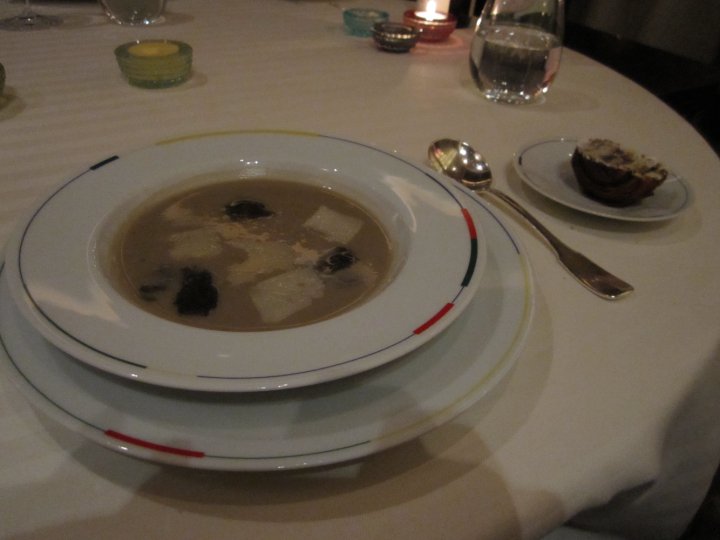
The famed truffle artichoke soup at Guy Savoy, Paris, named the 78th best restaurant in the world
This is riveting excitement, isn’t it?
We’re not going to go into deep ESPN style analysis here, but here is what jumps out initially after hearing the results.
Noma as the winner is no surprise at all. Much of the drama coming into yesterday was whether or not somebody could overtake Noma or if Noma had possibly gone slightly downhill. Nobody can truly say this restaurant is absolutely, no doubt about it the best restaurant in the world because restaurants change every night. Really what this ranking shows is who is the most influential. Who is changing the way we think about food and prepare food the most? Who has been consistent at doing that, while having an world class restaurant experience every visit? As shown by winning again and the recent inclusion of René Redzepi into the Time 100, that answer certainly is Noma.
Per Se the top American at sixth…French Laundry at 43rd? I haven’t been to the French Laundry, but it’s very surprising to see 42 restaurants above it, especially its New York sibling so much higher.
No France restaurants in the Top 10. And the top restaurant in France is L’Atelier de Joel Robuchon, a restaurant with no tables.
Great to see Sweden with three entries: two new and one re-entry. Also great to see Portugal with its first ever entry.
Especially when you look at the 100 restaurants listed, a very big year for small, chef-driven European bistros with chefs who used to be chefs at the mega-restaurants of Europe.
This list loves modernity. That means classics such as the haute cuisine of Roanne France’s Maison Troisgros and the pure, honest Northern California cuisine of Chez Panisse shouldn’t be on the list? Wrong.
Big year for the San Francisco Bay Area: Chez Panisse, the French Laundry, Coi, and Manresa…and Meadowood, Benu didn’t even make the list.
Surprising to see nobody from Los Angeles and some of the classic “destination restaurants” such as The Inn at Little Washington, Willows Inn, and Blueberry Farm not make it.
None from Canada.
Two from Japan and neither is a sushi specialist. Clearly this list and Michelin stars don’t allign together.
To take away from this, debate is pointless because on a good night, all of this restaurants are at the peak of gastronomy and the restaurant experience. You will have a meal you will never forget at any of them except on rare, very disappointing occasions. It’s certainly happened to me at some of these places unfortunately, but more often than not they are absolutely worth the splurge. The list shows an appreciation of science, sense of place, sense of creativity, and using all of your senses in these meals. There needs to be something thought-provoking about the experience and something whimsical or theatrical, yet also nourishing because food after all, is meant to be consumed, and not read or watched.
Speaking of these restaurants, I don’t know the answer, but it would be fascinating to count how many of the hundred mentioned have kitchens viewable from the dining room and how many have tablecloths on the tables? Formality certainly is not mandatory to be one of the world’s “best” restaurants.
Then again, what is formality? We’ll have that James Joyce-ian debate another day.
Speaking of formality, foie gras is an ingredient always associated with luxury and formal dining. Beginning this July 1st, California soon will be banning the sale of foie gras on the basis of animal cruelty with the force-feeding of geese in the production of foie gras.
I agree fully with Pastore and the hundreds of chefs in California who have signed a petition against this bill. Nobody supports animal cruelty here. We all support the production of foie gras, while safely feeding the geese without torture and brutality. As Pastore points out, there are no problems these people have with any other animals that are very likely treated in brutal ways much like the geese. A slaughterhouse doesn’t seem to peaceful for the cows.
Foie gras is the target because this being 2012, foie gras represents the elite, the 1%. Pastore mentions how maybe two to three dozen people any given night may eat foie gras in San Francisco. It is not a mass commodity, which means it is much easier to restrict animal cruelty in its production. Yet, the government chose to bypass any intelligent legislation to implement new rules to insure the geese are treated humanely. They just decided, like Chicago did in 2008 and then repealed two years later, to just flat out ban foie gras.
It’s a moral issue for Senator John burton and the anti-foie gras advocates. It’s an understandable side. It is best to understand all sides to an issue, though. Not all foie gras production is bad. To really make an impact for animals, ban the production of meat. Ban the practice of deep sea fishing for endangered fish.
There are bigger issues at hand than foie gras in the food world. Instead of a flat out ban, let’s continue to support and practice the humane raising of these geese that many farms already practice.
Lastly today, shame on the protesters in San Francisco’s Mission District last night who went several steps beyond peaceful in attempting to occupy…can you even figure out what they really are aspiring to occupy? Here’s The San Francisco Chronicle article from this morning detailing the route of pointless destruction by these protesters. Many restaurants were among the businesses paint-bombed, including some of the city’s best: Bar Tartine, Tartine Bakery, Farina, Locanda, and Four Barrel Coffee. Luckily it doesn’t appear anybody was seriously hurt, even when trying to hold back protesters from crashing windows with crow bars. Reports are uncertain who and why these protesters were even causing this chaos in the first place. There are hints of anarchy for certain and the continually failing but trying to stay alive Occupy Movement appears to have a part as well.
Obviously, these senseless acts achieve nothing other than to shatter innocent people’s businesses, cars, and homes, along with wreaking havoc simply because they are angry with something or someone. As the Chronicle article mentions in a quote by Adam Kosskoff, the manager of Locanda Restaurant who was paint-bombed by the protesters and who himself was egged by one, the businesses in this district are exactly the types of small, humble enterprises…who the protesters support! That being said, to say these protesters have common sense would be impossible. After all, they even tried to occupy the Mission District police station.
For those of us who have parked often on these particular streets and dine at these restaurants, it’s scary and ludicrous that such protests and chaos can exist. Shame on these protesters who accomplished nothing except making all of us continue to shake our heads at them.





 Trev's Bistro