After a small weekend snafu where some members of my dining party had under-estimated the time and formality of a meal at a certain restaurant I had arranged for us to visit, let’s take a look at some of the most commonly asked (some serious, some…less so) questions when you’re the “foodie” and everyone puts their faith in you whether at a hole in the wall ethnic cuisine dive or a blow out special occasion, for a tremendous dining experience every time out.
How fancy is this place?
This is no doubt the most frequently heard question. Everyone for some reason associates people who are passionate for dining, as people you are going to spend a lot of money with. They imagine meals at Les Ambassadeurs or Charlie Trotter’s every time they join me, whether it’s really for a ramen lunch or casual bistro dinner. I despise the word “fancy.” Fancy is if you joined Louis XIV for a state dinner at Versailles. “Upscale,” “elegant,” “sophisticated,” “chic,” “cutting-edge,” are all much better adjectives. Then of course there are the darlings of food writers, such as “neighborhood bistro,” “hole in the wall,” “quick casual,” “casual chic,” “dive”…the list goes on. Essentially the “fancy” question has to do more with “What should I wear?” and “What is the price?”
What’s the cuisine?
This is always a challenge. More often than not a place is “Regional American” or “New American” or “Californian”…what about if it’s a pizza place that also has excellent sides? How about Mission Chinese Food? Yes it’s Chinese…but very different too.
Who’s the chef?
Excellent question. However, the answer always seems like a let down these days if he or she is not on t.v. That’s too bad since probably 0.00001% of terrific chefs have any t.v. exposure.
How do you pronounce prix fixe? (Or anything French…)
Having graduated as a French major, I expected to hear this a lot, and usually have the answer. No problem. Except with prix fixe. Is it really like how the French say (Pree- fix) or should we English-ize the pronunciation like I hear so often (Price- fix)? Tough call.
Beer, wine, or cocktails?
Usually research has been done in this subject long before going to the restaurant. If you’ve heard of a great cocktail program, start out with a drink. If there is a very special draft beer list, get one at lunch. Otherwise, wine.
How did you hear about this restaurant?
A complicated algorithm involving quantum physics, organic chemistry, levers and pullies, glucose, and a dash of worcestershire…also known as lots of reading of magazines and newspapers (NOT Zagat), research on the internet for reviews (trusted sources, NOT Yelp), Chowhound, and word of mouth from friends and family.
What are some of your favorite (or non-favorite…) questions asked? The list goes on and on like a meal where the service is clearly in the weeds.
One great restaurant I heartily recommend, Aldea in the Flatiron District of New York. Everything created by chef George Mendes is genius and a unique Portuguese-American hybrid, such as this arroz de pato with duck confit. Food always tastes better after seeing the chef prepare it! It’s way, way more than just “duck with rice,” as the recipe shows.
Speaking of New York, we’ll make David Chang’s Momofuku Short Ribs later today for the Tuesday project. Have a terrific rest of this Tuesday!
Claiming that Yountville is a world class city for food and wine is as innovative as proclaiming that Paris is a world class city for art.
Yountville, really a small town instead of a city, boasts a population of barely over 3,000. It also boasts a population of six Michelin stars, three of which are owned by an up and comer restaurant called the French Laundry. Half way between Napa and St. Helena, about eight miles to either, Yountville is the charming small town that a premier wine region needs, and that the rest of the touristy, commercial Napa Valley towns are not.
Despite having the French Laundry and a staggering ratio of high caliber destination restaurant to population, Yountville remains essentially a humble, one street, Main Street USA town: Washington Street. From one end to the other of the business district of Yountville takes no more than 20 minutes to walk, running parallel to the nearby Highway 29. Not on Washington Street, but at the southern exit for Yountville on 29 resides Domaine Chandon, the famed sparkling wine house owned by Moet et Chandon. Chandon’s restaurant Étoile is excellent and the winery itself has some intriguing artistic touches such as the meadow of gigantic mushroom sculptures between the parking lot and tasting house. The sparkling wine isn’t too shabby either.
Cross 29 on California Drive, hang a left on Washington, and here comes restaurant after restaurant. The hits keep on coming. Starting with Ad Hoc, the formerly “temporary” restaurant of Thomas Keller’s that was supposed to become an haute burger restaurant. When I receive Ad Hoc’s single menu with no choices each day, I am always tempted to book my ticket to Yountville. Dave Cruz is the chef in charge of Ad Hoc day to day, crafting the four courses of salads with French Laundry produce, a hearty main course, a cheese, and a dessert that tends to be a comfort food type such as peanut butter bars or mini carrot cake cupcakes. Recently opened from a renovation, Ad Hoc now offers a fifth course add on, which seems to be always a pork belly the past two weeks. Mondays are the nights of choice at Ad Hoc, alternating between barbeque and the superb buttermilk fried chicken, easily the best I’ve ever had. With the spring and summer season upon us, the backyard of Ad Hoc has become a lunch take out spot, Addendum, serving exclusively the fried chicken and barbeque.
Next door to Ad Hoc is Redd, the most ambitious and cosmopolitan of Yountville’s restaurants other than the French Laundry. Redd is chic in a leisurely wine country style, with excellent creations by Richard Reddington, especially the glazed pork belly with burdock root, apple purée, and a soy caramel. Though pastry chef Nicole Plue has moved on to Cyrus in Healdsburg since my last visit, don’t skip dessert.
The high end hotel and spa Villagio resides across from Redd and next door is, this being wine country, the tasting room for Somerston, and the Yountville Deli for picnic items. Along Washington you’ll find also the Hill Family Estate tasting room, Page Wine Cellars, and Cornerstone Cellars. It’s all convenient, but remember, these are tasting rooms without the vineyards in the background. Bistro Jeanty, Phillippe Jeanty’s très français bôite, is an excellent stop for a lunch croque monsieur or steak tartare and escargots at dinner. Hurley’s is another popular spot for more straightforward California fare.
The central stretch of Yountville veers away from the California regional feel of Ad Hoc, French Laundry, and Redd, and somehow becomes part Paris and part Tuscany. Along with Bistro Jeanty, Thomas Keller’s Bouchon started what is now a mini-empire of brasseries striving to transport you to a bistro by Opéra Garnier. Bouchon’s moules frites are as good as any in Paris, so are the chocolate bouchons (wine corks) for dessert, served inside a belle époque setting that actually is more Parisian than almost any brasserie or bistro (except Benoît) I went to for six months living in Paris. Next door’s Bouchon Bakery, recently opened up from a fire, has some of the best muffins I’ve tried, those exquisite bouchons, and baguette sandwiches that draw lines a mile long at lunch. There are now Bouchon Bakeries and Bouchon Bistros in L.A., Las Vegas, and Time Warner Center in New York.
Across from Bouchon is the V Marketplace, with the charming Yountville Coffee Caboose and Michael Chiarello’s outstanding restaurant Bottega, along with its next door sibling food and wine shop Napa Styles. Both the shop and the restaurant strike you as oh so Italian with their rusticity, but have the sunshine purity of California wine country. Together, the two scream Napa Valley. At Napa Styles, a jar of the parmesan dip you receive with the fresh baked bread at Bottega is obligatory. At Bottega, the menu is epic in length and beautifully blends Chiarello’s Tuscan and Californian sensibilities better than any restaurant I can think of. Everything deserves to be ordered. The polenta under glass with aged balsamic and caramelized mushrooms, the smoked and braised short ribs with a quince paste and the greatest spaetzle ever made, a pasta such as roasted potato gnocchi with spring vegetables and English peas puree, and a bottle of a Chiarello Family vineyard wine make for as perfect a meal as I can imagine. Bottega represents the family importance of sharing and being together of Italy with the tweaked, but pure sensibilities of California dining.
Past Bottega, Yountville becomes more residential. Bed and breakfasts such as the Bordeaux House and one of my favorite tiny parks (Van de Lear Park) lie along the right side of Washington going north. There’s a garden then on the left with all sorts of produce for a certain restaurant and across from the garden is a tranquil former laundromat turned restaurant, also known as the French Laundry. Yours truly will dine there one day, but we have heard that it’s a pretty good restaurant. We’ve seen lots of pictures, heard stories, and spent hours and hours unsuccessfully on the reservations line.There’s no way to deny that the French Laundry is the most important restaurant, yes more than Chez Panisse, in this country’s culinary history.
Beyond the French Laundry are the Roots Run Deep and Jessup Cellars tasting rooms, along with Richard Reddington’s new pizzeria Redd Wood inside the North Block Hotel and the town’s Mexican dive taqueria, Pancha’s. At the end of Washington before it veers west towards Highway 29 resides Veteran’s Park, an excellent choice of picnicking with whatever you picked up at Bouchon Bakery.
It doesn’t get much better than Yountville. A charming small town with world class dining and the world’s greatest vineyards surrounding it, yet still incredibly down to earth and avoiding the rest of the commercialism that envelopes the Napa Valley. It could take only 20 minutes to walk from end to end of Yountville. It would take a week to eat all of the meals at the worthy restaurants in this town.
The final full week of April is here and in much of the country that was enjoying an early summer last week, winter has returned. Time for more hot chocolate and beef stew now…
We’ll get to “spring” in a moment, but the big excitement of the day is the announcement that René Redzepi, chef of Noma in Copenhagen and last week named one of Time‘s 100 most influential people in the world, will be taking the Noma show on the road for the first ever time outside Copenhagen, with “A Taste of Noma” at the Claridge’s Hotel in London’s, one of London’s most upscale hotels in Mayfair, one of London’s most upscale districts. Eater National has more information on the pop-up, along with the official press release.
Prices are estimated to be $313.66 for the pop-up from July 28- August 6. Noma is re-modeling for a month mid July-mid August, allowing Redzepi to take Noma off the Copenhagen island (some of us had to plan a certain trip around this month long hiatus at the restaurant…). Remember of course that Thomas Keller, one time mentor of Redzepi at the French Laundry, started the pop-up excitement in London last October at Harrod’s.
Is London so popular with pop-ups because chefs see the city as a major city under-served by the caliber of its restaurants with only two Michelin three stars? Uh, no. It’s the opposite. For any art, be it visual, performing, or culinary, London right now is at the peak for excitement, creativity, and glamour. Plus, with the Queen’s Jubilee and the Olympics this summer, there is no doubt that London is THE destination period for 2012. The second biggest destination…probably to eat at Noma, in its regular home, Copenhagen.
Three quick thoughts from today’s announcements. Of course the dates reflect when Noma is renovating, but it also is during the Olympics. Is this a good or bad choice knowing how swamped the city will be? Will the athletes break their strict diet to eat at Noma London? Like with athletes, there is no bigger stage than the Olympics. This is an excellent decision by Redzepi to visit London during the end of July.
Also, have to wonder for such an intensely regional cuisine like Redzepi’s New Nordic at Noma, how will that be reflected and interpreted in London? How will famed chef Gordon Ramsey, he of Gordon Ramsey’s at Claridge’s Restaurant, welcome another famed chef into the same hotel in the city he is a superstar in, during the city’s moment in the global spotlight?
Last week we showed you the New York Times‘ Jeff Gordinier writing about the recent love being sent towards the lowly anchovy. Anchovies continue to gain lots of love beyond their cramped cans now from San Antonio’s leading chef and food writer: Andrew Weissman and Edmund Tijerina. I absolutely love the concept of “King Anchovy.”
It’s always fascinating to read the backgrounds of famous sandwiches, from the Earl of Sandwich’s sandwich to the heated debate over the “hamburger sandwich” at Louis Lunch in New Haven, CT., and several other competitors. Today, where is the Cuban sandwich from: Miami or Tampa? Did the Cuban sandwich even originate in Cuba? It certainly seems agreed on that the sandwich was “perfected” in the U.S. (or really, by Bunk Sandwiches in Portland, OR if you’ve ever tried that exceptional pork belly cubano…)
How about the po boy? Obviously, New Orleans, right? Possibly at Mother’s? Or could the oyster po boy be from…San Francisco?!
It’s lots of fun and very enriching to learn the origins of what we eat. It’s healthy to know where our food comes from, both the actual food and the ideas behind the food. It’s a lot more fun to debate too the history of food than say, political history.
So often we food writers dwell on reviews that slam restaurants. Enough of that. Yesterday Michael Bauer of the San Francisco Chronicle re-confirmed that Quince, Michael Tusk’s formal Northern California-rustic Italian restaurant in the city, deserves its exalted four star status. Here is the review and some beautiful pictures to make us all dream of dining there. Having been to Quince’s little sister Cotogna, located next door, Tusk is truly a wizard with pasta and so much more. He proves that Italian cuisine can mean so much more than we ever knew. He doesn’t force himself to be Italian all the time, as it’s creativity and seasons that dictate what will be an optimal dish. Now don’t be surprised if the next major wave of destination, four star restaurants come in the form of the Italian-meets global-meets local/seasonal emphasis of Quince.
Finally on this Monday, some spring food for thought. Peas, fava beans, strawberries, ramps, artichokes…spring produce certainly are in full bloom on menus this week. This past weekend at Michael Chiarello’s Bottega and excellent rustic California-Italian Oenotri, both in the Napa Valley, enjoyed some exquisite dishes featuring the season’s famed produce. Everything was superb at Bottega in Yountville, especially the potato roasted gnocchi with an English peas puree and various spring vegetables including brussels sprouts leaves. Oenotri pairs wood oven roasted young fava beans with beets, citrus, pistachios, and sunflower sprouts for a pristine, perfect starter. We’ll hear lots more about these restaurants later in the week, along with lots more from a weekend family birthday celebration in the Napa Valley.
And doing some research for an upcoming trip, nobody can beat Portland, Oregon when it comes to listening to local, seasonal produce. Naomi Pomeroy at Beast uses green garlic in a vinaigrette and fresh mint too for cured salmon, first of the season morel mushrooms in a butter for Modoc Mountain leg of lamb, and rhubarb for dessert in a rhubarb brown butter tart. Natural Selection, a fascinating young vegetarian restaurant in Northeast Portland, is a go to list for anything seasonal: roasted beets & stinging nettles with watercress and kumquat relish or roasted abalone mushroom atop a…you guessed it…ramp risotto. We had to have ramps mentioned somewhere on this list!
Hopefully the Red Sox can be revived in the chilly spring air of Minnesota this week…maybe some rhubarb or green garlic or ramps could help? Have a great Monday!
It was a fairly quiet week for dining out, though things will start up again this weekend with a few Napa visits (but those reviews wait until next week!).
Mission Chinese Food
Mission Chinese Food, San Francisco
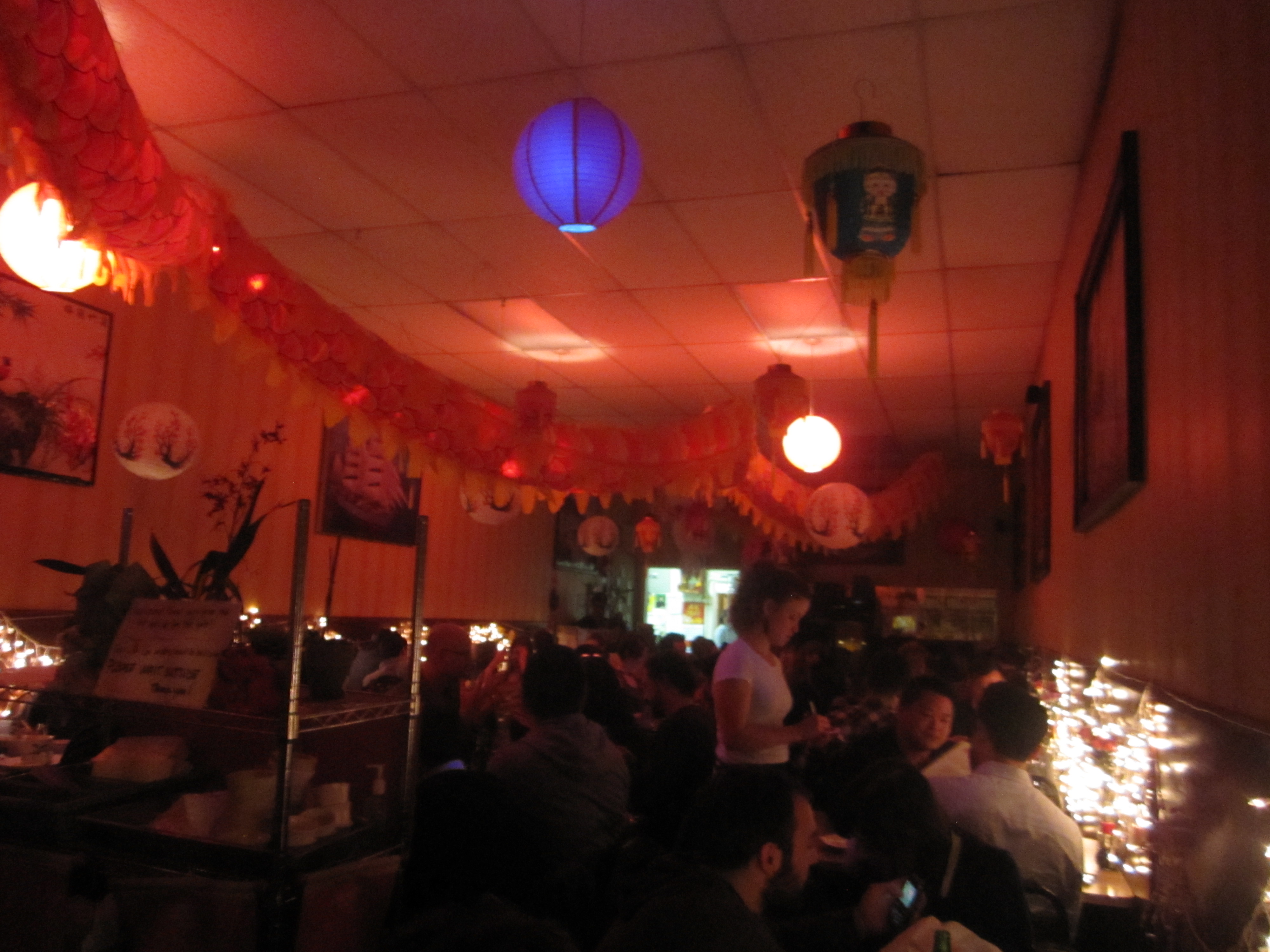
Quite possibly the most talked about restaurant in San Francisco, Mission Chinese Food perfectly shows where dining is 2012. It’s a pop up, yet also a restaurant. A little over a year ago, Anthony Myint and his wife Karen Leibovitz (of the pop up Mission Street Food and next door restaurant to Mission Chinese Food, Commonwealth) took over the Lung Shan Chinese Restaurant on Mission St. at 18th, that was not exactly on the radar of area food followers to say the least. They hired Danny Bowien, a chef best known for winning the World Pesto Championship in 2008.
There’s not a lot of pesto on the menu here, but a lot of gusto to Bowien’s Szechuan influenced, far global reaching menu. Bowien now is preparing to open the first off Mission offshoot of the restaurant, in New York. Luckily, the kitchen is hitting on all cyliners without his daily presence. This is Chinese food in inspiration and family style servings. The creations though represent the sheer vibrant diversity of San Francisco.
The cooking, the service, and even the atmosphere (the restrooms are not hideous anymore) have all smoothed out, becoming crisper and more refined since my initial visit last July. Then, the ma po tofu’s spice forced me to drink an entire swimming pool, and the enticing broth, chunks of tender Kurobota pork shoulder, and buttery cubes of tofu made up for the palette dulling spice. Those peppercorns that Szechuan cuisine is famous for numb your taste in a good way if that’s possible to say.
No longer on the menu, Bowien made an excellent Chinese barbeque sampler with hot links and fork tender brisk, a mash up of Fort Worth and Shanghai if I’ve heard of one. Bowien’s silky chilled egg custard is excellent with briny sea urchin and tiny scallops. The addicting Beijing vinegar peanuts and variation on kimchi cucumber pickles are excellent for beginning snacks. The heart of the order comes in the large plates. Sizzling lamb belly is excellent, coated in the Northern Chinese Islamic style with pungent cumin. Shanghai chow mein comes tossed withpork trotters and rock shrimp, while the simple sounding beef brisket noodle soup gets jazzed by a cardamom broth. The only dud is the salt cod fried rice, begging for less grease and more salt cod to liven the proceedings.
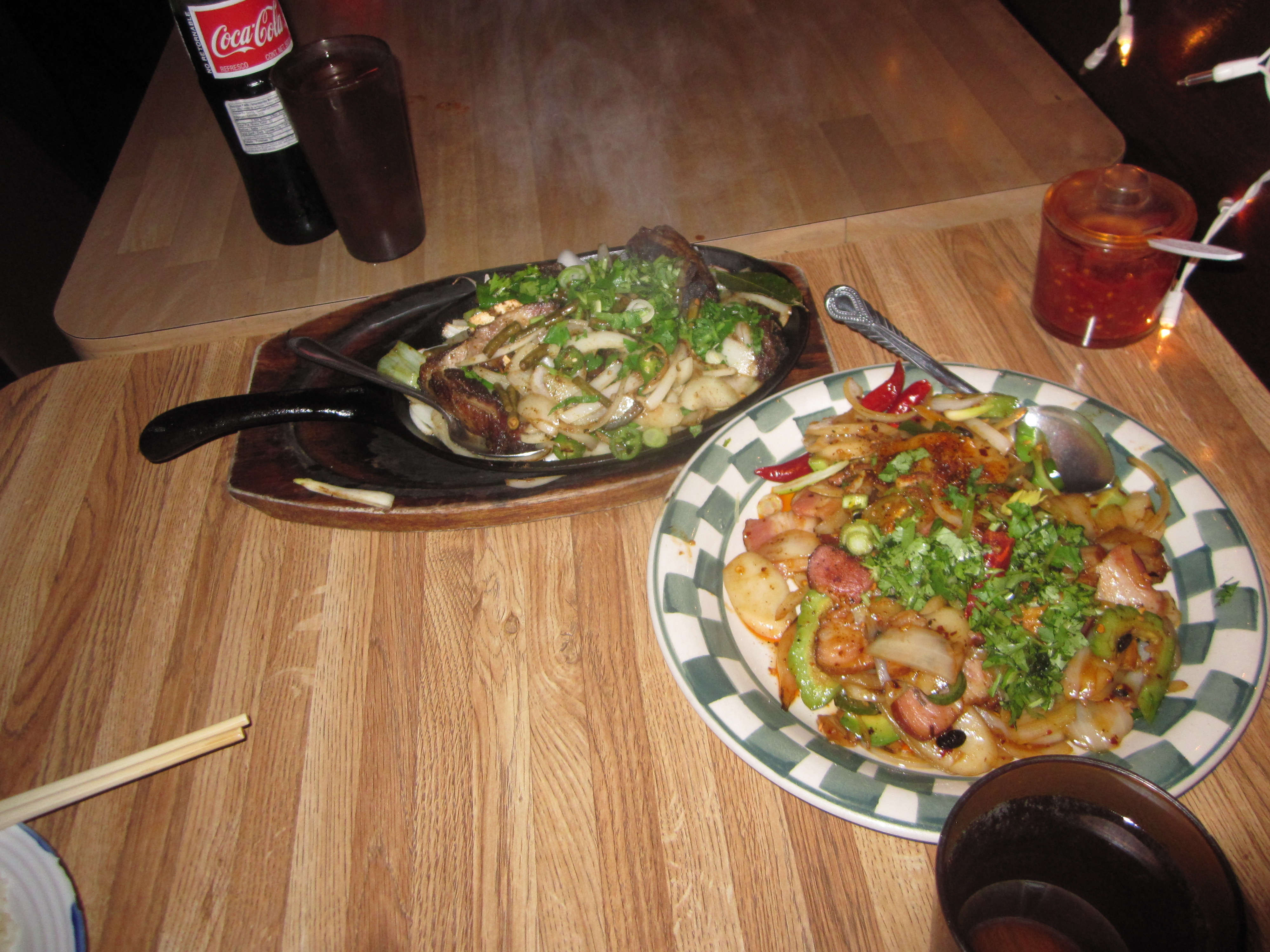
The stand out is the thrice cooked bacon tossed in chili oil atop a mound of miniature sweet rice cakes like lilly pads on a pond, tofu skins, and black beans. It’s not exactly your neighborhood take-out Chinese dish. My one wish at Mission Chinese Food would be to cut down the portion size, trim the already shockingly low prices with the portion size, and allow us to sample more of this exciting creations. I can’t imagine how popular the place would with everything tapas style.
It’s a party every night (except Wednesdays, beware!) at Mission Chinese Food. Even the wine and beer lists have slightly improved, with 3-4 options for each, including the terrific 21st Amendment Back In Black IPA, where hops meet stouts.
A year in and expanding to New York, Mission Chinese Food is better than ever and just as popular. Come at 9pm on a rainy weekday night and then you don’t have to wait!
Espresso at Barefoot Coffee Roasters
Barefoot Coffee Roasters, Santa Clara, CA
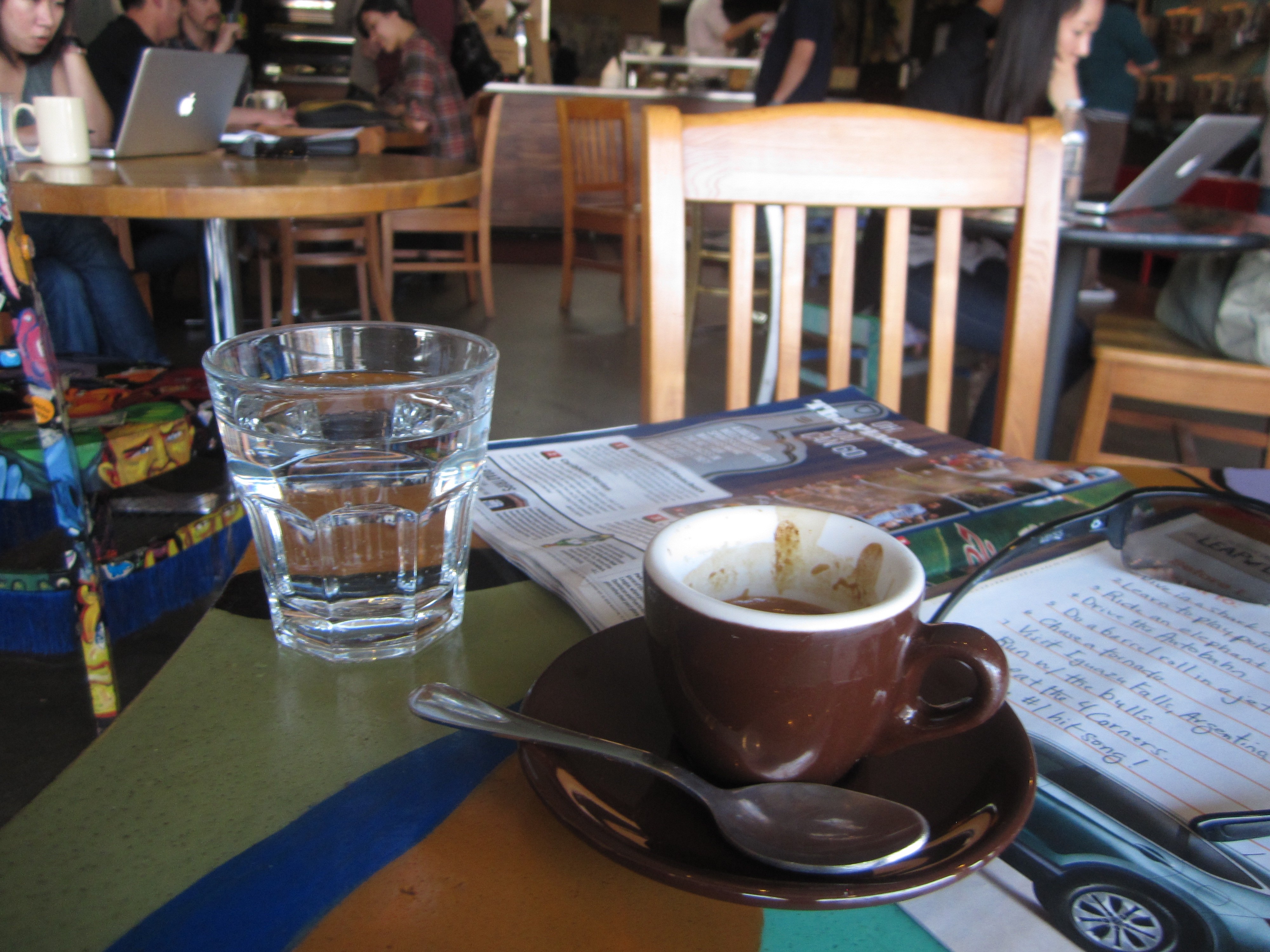
A terrific espresso is pulled by the baristas at this oasis of quality third wave coffee in a random mini mall in a random area of Silicon Valley. The espresso comes a bit on the sour side like at Four Barrel, with some clove noticable, and an excellent crema. The music is hypnotizing, making everyone feel as zoned out as the baristas can sometimes soon. They do know how to make coffee here, dazed, or not.
La Trappe, San Francisco
La Trappe, San Francisco
A somewhat hidden gem of a Belgian beer bar and restaurant to get your moules frites and Tripel on. Tucked between touristy North Beach and touristy Fisherman’s Wharf, this is one of the city’s premier destinations for top notch European and American craft brews. Bartenders are incredibly knowledgeable as if they make the beers themselves and I can’t think of a much more charming setting than the cozy brick exposed cellar room downstairs. It’s perfect for a date or contemplating the superb Jolly Pumpkin Madrugada Obscura Dawn Imperial Sour Stout. Yes, that’s the name of the beer I had.
Joy Restaurant, Foster City
Having been to Taipei, Taiwan last summer, searching far and wide at night markets for the classic stinky tofu, I thought I found some, but clearly there was a missing link in the translation as the tofu was none too stinky. So I finally found time to seek out this traditional Chinese restaurant with a small specialty in Taiwanese specialties, in particular stinky tofu. You can get it fried or steamed in a similar way that Koreans serve soontofu, in a broth of boiling chili oil topped with chunks of pork, onions, and black beans. Joy ferments its own tofu. This is the real stuff, foul to the nose from when it exits the kitchen. The taste is intriguing, but ultimately not as exciting as an aged cheese would be. Then again, this is tofu we’re talking about. You end up feeling bad for the tables next to you and realize your clothes are going straight to the washer.
Interestingly enough, the special dish was an excellent recommendation by the waiter who could barely communicate to me his thoughts. On the menu it’s called “sliced gluten,” as unexciting as wheat germ or “pencil” might look on a menu. Guess again. Cubes of hoisin marinated seitan get tossed with edaname beans and shitake mushrooms for a fantastic starter. Gluten never tasted so good, especially with the stink of the tofu nearby.
Caffe Roma, San Francisco
Even though this North Beach cafe roasts its own beans, the espresso is as watery as I had recently at SFO. Very kind baristas and the back room’s leather banquettes makes you feel like a Beat Generation author. The bum sleeping on a table there made me feel like this is San Francisco.
Mario's Bohemian Cigar Store
Mario’s Bohemian Cigar Store
No, not a cigar in sight, nor is this is a store. It’s a charming, North Beach stand by on Columbus, overlooking Washington Square Park. While next door’s Original Joe’s is massive and rowdy, Mario’s is miniscule and organized, with seating mainly at the 10 seat or so bar. It’s a rare local’s joint in this area, despite Frommer’s being in love with it. The espresso sadly is very bland and watery like Caffe Roma, but the atmosphere and tempting looking pizzas from the oven behind the bar, make this more than worthwhile.
We’ll see where next week takes us, have a great weekend!
Some excellent dining the past week, as spring is now in full force.
Amberjack Sashimi with Seaweed, Black Trumpet Mushrooms, Ash, and Snap Peas
Amberjack, Seaweed, Ash, Black Trumpet Mushrooms Snow Peas at Aziza, San Francisco
Maybe not very Moroccan, but this de-constructed sashimi from Mourad Lahlou is similar to what you’d find at a 3 star Michelin sushi bar in Tokyo. The pure, clear flavors are dazzling.
Chairman Bao's steamed baos, spicy chicken is the one with yellow pickles
Spicy Chicken Steamed Bao with Toasted Sesame Puree, Cilantro, Carrot-Cucumber Pickles at The Chairman Bao Truck, San Francisco
There is spice to the fork tender chicken in a delightful, hummus like sesame seed puree, with some addicting pickles as a garnish.
Thrice Cooked Bacon on the right, Mission Chinese Food
Thrice Cooked Bacon with Rice Cakes, Tofu Skins, Chili Oil, Black Beans, Bitter Melon at Mission Chinese Food, San Francisco
The smoky bacon mingles with the sweet lily pads of rice, the funk of bitter melon, and some spice to round it out in the chili oil broth. An exceptional dish.
Krazy Krab Sandwich, AT&T Park, San Francisco
The Giants know how to build a ballpark and they know how to make some of the best and priciest ballpark food in the country. The Krazy Krab is quite simple, as a crab sandwich on toasted garlic sourdough bread. Paired with an Anchor Steam while watching Matt Cain pitch, this is baseball at its finest.
Aziza is one of the most fascinating restaurants and restaurant stories in the country. There aren’t many Moroccan restaurants in the country period. There certainly are even fewer restaurants with daring chefs like the incomparable Mourad Lahlou bravely, often brilliantly re-designing Moroccan cuisine into a new global modern cuisine altogether, with a few influences from Morocco evident in most dishes. Some dishes may even have nothing to do with Morocco, but that doesn’t change the accomplishment created by the chef. Aziza is a thrill ride from the moment you set foot inside from the foggy, bustling stretch of Geary in the Richmond District, known more for dim sum restaurants and Russian bakeries. It is truly a transformative experience.
Laulou is a fearless titan in his quest to bring Morocco’s cuisine to prominence, while evolving it into the modern culinary language. After growing up in Marrakesh, Laulou came to San Francisco at 20 years old to study economics. As exciting as supply and demand curves can be, they are nothing compared to the vibrant cooking of Morocco. His first restaurant, Kasbah, opened in 1996 north of San Francisco, then closed, and Aziza opened up in San Francisco in 2001. Aziza started as a slight tweak of traditional Moroccan cuisine. That tweak has become a gradual evolution over a decade to some of the most complex cooking on display in a town full of daring chefs. His recent cookbook Mourad: New Moroccan is a hit across the country, though not exactly full of recipes that are for home cooks any less complex than what you’ll find in an El Bulli cookbook.
Spreads: Chickpea, Yogurt-Dill, and Piquillo Pepper-Almond
This is cooking full of spice, full of life, and full of personality. Moroccan traditional dishes do make an appearance. Nearly every tables commences with freshly baked flatbread to dip into a trio of spreads: a high caliber chickpea hummus, a refreshing yogurt-dill, and the best, a soulful brick colored piquillo pepper-almond. Couscous resides on the menu, though not in the traditional style with vegetables and their broth ladled on top, perhaps with some grilled merguez sausage too. I enjoyed Lahlou’s traditional couscous royale years ago with that merguez sausage. Now, the couscous comes with brassicas or artichokes and ramps.
Tagine? Not here. There is the classic basteeya, evolved to be filled with duck confit instead of the traditional pigeon. Basteeya is a phyllo dough wrapped pigeon meat pie, dusted with cinnamon and sugar, for at its best a magical sweet-savory experience. At its worse, basteeya is a dessert gone haywire. Not at Aziza, where the piping hot parcel balances both ends of the flavor spectrum perfectly. The one issue with ordering it with a small group is that the serving is large for an appetizer, and the basteeya very filling. At Aziza, sampling as many tastes as possible is paramount.
Amberjack Sashimi with Seaweed, Black Trumpet Mushrooms, Ash, and Snap Peas
You’ll find basteeya in Marrakech. I guarantee you won’t find the magnificent amberjack sashimi there. Lahlou loves de-constructed presentations. The amberjack presentation is abstract, de-constructed sushi featuring a quartet of thin slices of pristine white flesh next to minute beds of seaweed and the cutest halved snap peas with the peas themselves looking like water droplets on a green log. It’s a work of art visually and to the palate. This is the type of care and purity a leading sushi chef in Tokyo would serve for you after waking up at 4 am to buy the fish at Tsukiji Market.
More creativity is on display everywhere in the menu where chicken wings comes with sunchokes and currants, and the Fergus Henderson fan club will cheer for sweetbreads AND bone marrow together with lily bulb, romaine, and scallions.
Chicken Roulade with Hen of the Wood Mushrooms Tempura, Green Garlic, and Celery Root Purée
With hit after hit for appetizers, main plates veer towards being slightly smaller than most main courses tend to be, allowing for more dishes to be ordered. Green farro arrives in a creamy risotto-like dish with slivers of scallop tossed about the farro, as opposed to the standard whole scallops on top of the farro. The shavings of Himalayan truffle and diced carrot are pure genius atop the dish for a rich, salty, crunchy element. Chicken is as tender as a Peter Luger porterhouse, served in a roulade atop celery root puree. The green garlic, a real sign of spring, lacked any flavor unfortunately alongside the chicken, and the much hyped Hen of the Wood (appropriate for a chicken…) mushrooms were overwhelmed by their tempura batter. One classic always on the menu is the braised lamb shank over barley with prunes, a stick to your ribs preparation you wish you could have for every Sunday supper.
No stone is left unturned at Aziza. The cocktails and the desserts follow the same complex prism. The bar program by Farnoush Delaymian is as riveting as Lahlou’s creations, with each cocktail focusing on an herb, spice, vegetable, or fruit. A rye selection with grapefruit, absinthe, and bitters ended up being far too heavy on the rye. I enjoyed but didn’t love the overly sweet wild arugula with tequila served up in a coupe, with a barely detectable turmeric root syrup. The tarragon cocktail with cachaca and cardamom pods and the riff on a margarita with almond and smoked salt foam both came highly recommended by the very helpful waiter.
Cocktails: Wild Arugula/Turmeric Root/Bitters/Tequila, in distance: Grapefruit/Rye/Bitters/Absinthe
The only miss on advice from our server came with the highly anticipated desserts. Melissa Chou is the darling of San Francisco pastry chefs, recently named a finalist for the national James Beard Best Pastry Chef award. Like with many of Lahlou’s creations, her desserts blend Morocco with the entire world, served in various components that can be put together or enjoyed as separate pieces entirely. The problem in this case can be an occasional creation where the pieces are great, but not necessarily when combined.
Pound Cake with Lemon Cream, Mint, Caramel, and Blood Orange
I appreciated Chou’s riff on a lemon pound cake, the usually dry, boring, ugly duckling of pastry chefs. Pound cake and fruit cake don’t move mountains like chocolate souffles. The small rectangles of pound cake serve as a platform for mini logs of lemon cream topped with icebergs of meringue, a clear take on lemon meringue pie. If the pound cake itself had a particular flavor, this could have potentially been special. The dots of blood orange, the quenelle of white chocolate ice cream, and thin pools of caramel sauce add some sweet and sour elements, but when elements are combined there is no unifying taste. The white on white presentation is a bit harsh to the eye too. The pound cake could use a flavor to liven the proceedings, but fortunately isn’t dry in the least. It’s a fine dessert, most likely not as stunning as lavender panna cotta with dates, rye, walnut cake, and malted vanilla ice cream, or the intriguing strawberry parfait with rhubarb, kumquats, pistachio, and my favorite dessert ingredient, beets in a sorbet.
The Richmond isn’t exactly a real nightlife area, but with some of the most unique cocktails and desserts in the city, one could even have a casual dinner elsewhere and drop by Aziza for cocktails and guava sorbet with kiwi granita (the nearby Tommy’s Mexican Bar is renowned for its margaritas if you’re inclined to have a real cocktail crawl bonanza). That would be a shame though to miss Laulou’s cooking. It’s the delightful problem at Aziza, you’ll never be able to order everything that deserves to be. Many chefs soon will follow Aziza’s trail-blazing blue print. It’s a blue print for prosperity when the cuisine, cocktails, desserts, and atmosphere sweep you off your feet to Morocco and the mesmerizing world of Mourad Lahlou’s imagination.
With a cocktail name like this, there are too many ways to imagine what a nightmare drink it could be. A cocktail tasting like guacamole? A project of a cocktail? A Stanley Kubrick movie?
In the hands of head mixologist Julian Cox, the bartender maestro of L.A. behind the drinks at Rivera, Playa, and Short Order, The Avocado Project is a downright brilliant successful project. Mission accomplished.
No, it doesn’t taste like guacamole. It does taste a bit of avocado, in a good way, like how a well rounded cocktail can be based off a muddled fruit or vegetable or herb. Cox introduces fresh avocado to ascorbic acid for the avocado juice, along with some fresh lime juice. Then the avocado is joined by 5 Island white rum and agave nectar for a bit of smoke and sweetness. The drink gets shaken and served up in a martini glass finished with salt.
The avocado pairs brilliantly with the agave and the white rum, achieving a smoky-sweet depth that excellent rum and tequila cocktails succeed at. Also at Picca, the exceptional year old innovative Peruvian restaurant from the red hot Ricardo Zarate, you can get a classic, well balanced pisco sour of course, or a very enticing Zarate’s Tomahawk #15 mixing rocoto infused mezcal with fresh huacatay and topped with cucumber foam. The list always is changing, but make sure to get a Julian Cox cocktail to go with the exceptional ceviches, causa sushis, and the outstanding anticuchos.
Be brave and go for the Avocado Project. You don’t need tortilla chips to dip into it.
It’s rosé time folks. Spring is in the air, baseball season in full swing (or for Europe sports it’s the semi finals of the Champions League for soccer), and hefty winter stews are making way for lovely salade niçoises. This is the time we drink rosé.
This new offering from the largest appellation in Provence at 50,000 acres, with vineyards creating some of the greatest rosés in the world. The famed Bandol, makers of possibly the finest rosé, are nearby but their own appellation.
This young 2011 made from a grenache blend is a perfect calm pink-salmon color, almost the hue of a sunset’s rays about ten minutes before sunset. The tastes are in that rosé strike zone, where slight sweetness from the ripe strawberry mingles with a touch of bitter melon. It’s a thirst-quenching wine like a rosé should be that also demands to be savored. The depth lacks a but, which probably will grow over three or four years. It would be perfect today with a young, creamy goat’s milk cheese, or even better this time of the year, with that smoked fish tartine or salade niçoise.
Is hefeweizen really a beer? Yes, despite it’s lack of hops, but sometimes wheat beers are so lifeless or so full of fruity notes that they take on a very unpleasant life of their own.
Not the case with the “Hue Hefe” Hefeweizen from the Los Gatos Brewing Company, in the small, charming Santa Cruz Mountains town of Los Gatos, known mostly for being the home of Manresa. This is the heart of wine country after all, but their civilized, very hospitable brew pub is an excellent spot for lunch, to catch up with friends, and of course watch the game.
It’s also an exceptional place to sample beer. Hefeweizen is always the quick first chug and finish on a tasting flight. Here, it’s the lager. It’s not a bad lager by any means, but has little going on to become special. The IPA is perfectly balanced, not too hoppy, and there’s a very solid Oktoberfest selection, a terrific stout that seems more like a porter in the body of a stout, and an ESB cask ale.
The hefeweizen though steals the show. It’s a strong banana nose and a strong banana taste without being odd. A little cinnamon can be detected without being overpowering. I’m a sucker for everything banana flavored, even enjoying plain banana beers. This is a whole level above from that. Banana shines through this hefeweizen much like excellent cherry notes hit on a sour cask ale. It’s a rare sophisticated and enjoyable hefeweizen.
Happy Thursday, with the weekend within sight we’ll have the cocktail of the week to celebrate with in a few months (along with the day late beer and wine of the week, lots of clinking glasses I guess today!).
But first, a big cheers to the Time Magazine 100 Most Influential People of 2012, a list we all wish to be on one day. Ranging from Jeremy Lin to Mitt Romney to Matt Lauer to…in the food world José Andrés and René Redzepi, the list is as diverse and fascinating as the people it’s listing.
You’d be hard pressed to think of a subject in 2012 that can eclipse the role of food in our daily lives. Whether it’s favorite restaurants or the global poverty challenges of clean water and food to put on a table, food is a vital subject much like world peace and the global economy. Andrés and Redzepi are both incredible success stories who also represent the avant-grade, or future of where cooking is going. Redzepi’s Noma in Copenhagen not just taught the world about foraging, but how a brutally harsh climate such as Denmark’s can still utilize its local ingredients with ingenious creativity and passion. Andrés has taken the molecular gastronomy reins from his former boss Ferran Adrià at El Bulli and made the subject human. What he has done for bringing Spanish cuisine into the American mainstream at his restaurants and in turn, brought culinary tourism to Spain, is incredible.
Interesting to see Adrià actually write the description of Redzepi, also a one time apprentice at El Bulli (and the French Laundry). Oh yes, Redzepi is only 34 years old too and at the helm of the “best restaurant in the world.” Whether it is the best or not doesn’t matter to Time. The list is about influence. Redzepi is remarkable in his relentless pursuit of evolving the forgotten Scandinavian cuisine. Redzepi is also a remarkable role model for the millions of prospective young entrepreneurs trying to carve a new niche.
It’s exciting to see Anthony Bourdain also chronicle the 42 year old Andrés. Andrés is the prime example of what a visionary chef-celebrity should be. His empire is just the right size. He has a clear appreciation for the future in modernism cuisine, yet loves to stick with the tried and true traditional (just see his olives 2 ways at The Bazaar in West Hollywood). He doesn’t need a television show or product line, instead preferring to be hands on with his speaking and teaching at Harvard or worldwide festivals. Andrés’ most brilliant invention to me is his collaboration last year with the National Archives on the “real” traditional American food. It’s exciting to imagine what might be next from Chef Andrés.
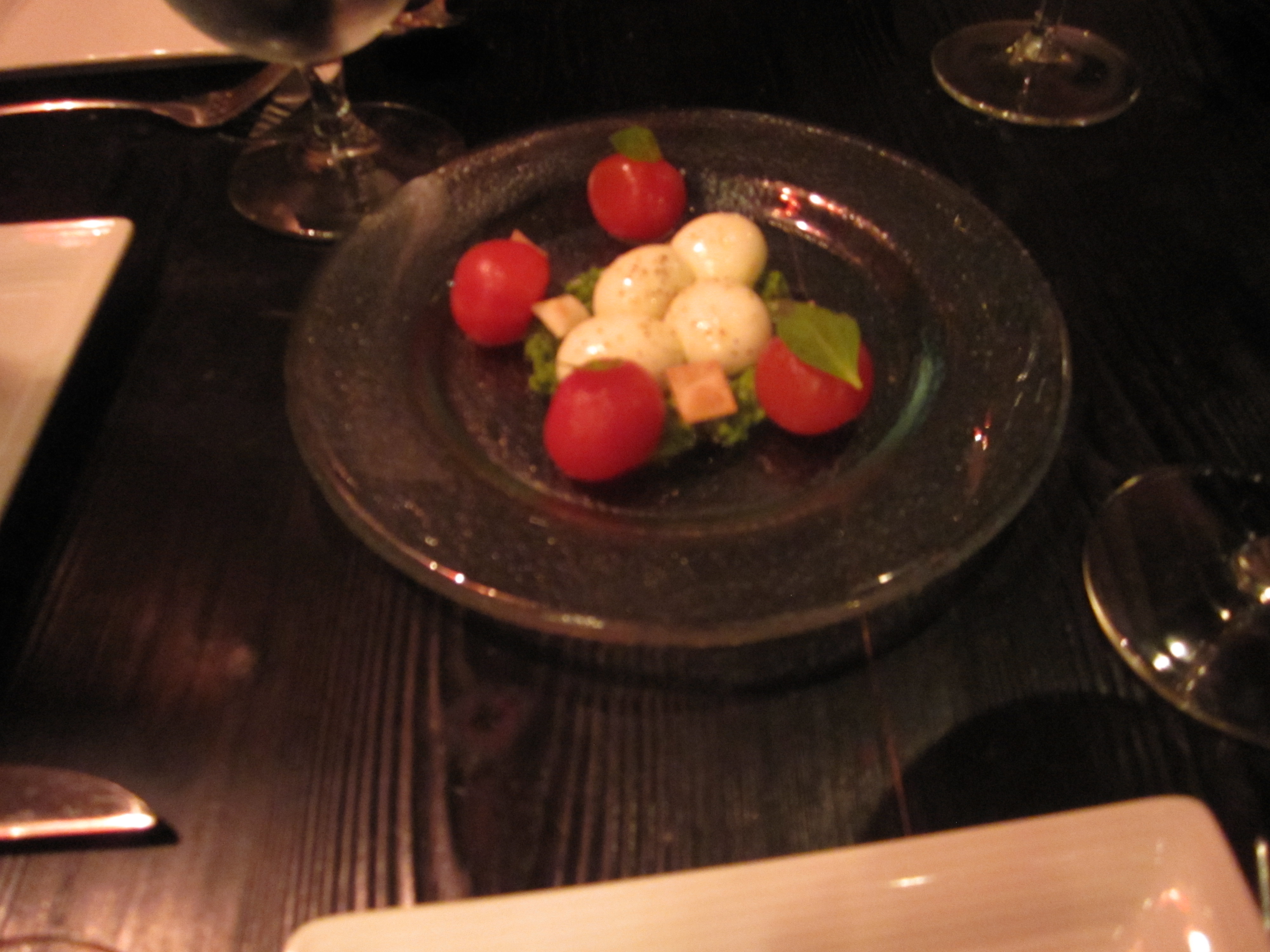
Andrés' version of a tomato and mozzarella salad at The Bazaar in West Hollywood
Meanwhile, not on the influential list, but important still, I had the chance finally this week to see “Jiro Dreams of Sushi,” the new documentary by David Gelb on the 85 year old sushi master Jiro Ono of Tokyo. I didn’t have the chance to visit Jiro’s 10 seat sushi bar in the Ginza subway station when I was in town last year, mostly due to the fact that you either must speak Japanese or have someone in your party speak Japanese in order to reserve there.
There is no doubt that the parade of majestic sushi images in the film will make you sprint outside to the nearest sushi bar afterwards (there happens to be a sushi bar right outside the theatre I saw the film). Jiro’s philosophy is very straightforward. He’s very rigid and organized, but not in a commanding way like a typical office box. Sushi is his “trade,” it’s what he has devoted his life too and he shall not complain about it.
The lighter parts of the film show there is some life behind these ever so serious sushi chefs, who cut chu-toro with the precision of a Swiss watch maker. Jiro does laugh, on the rare occasion. You never see his home life. You do see him visit friends in his hometown. You do learn a lot about his two sons, both whom he groomed to follow in his footsteps. It’s interesting to see the sibling rivalry with how in Japan, it is expected for the elder son to replace the father. So it’s the younger son Takashi who opened his own sushi bar in Roppongi Hills.
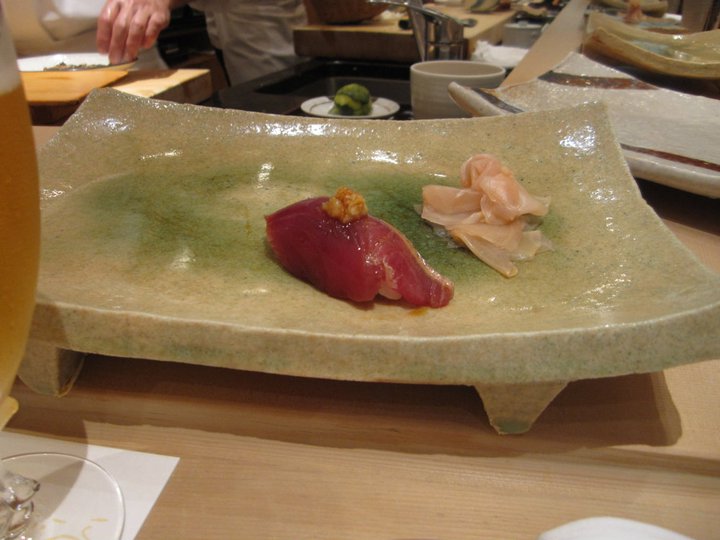
Chu-toro tuna sushi with minced garlic from June 2011 at Kyubei in Ginza, Tokyo
The most intriguing character actually is Yoshikazu, the now almost 60 year old eldest son of Jiro’s, who used to dream of being a race car driver. Sushi is a bit more tranquil than Formula One. Yoshikazu has the sushi world’s pressure on his shoulders when he replaces his Dad. The film shows him already going daily to the famed Tsukiji Fish Market, having replaced his Dad years ago. Of course Yoshikazu is the one who makes most of the sushi Jiro points out and is the reason the restaurant continues to have three Michelin stars.
Yes, the film really is more appropriate as a PBS documentary and there is very little drama. The climax is the real reason food lovers will head to see the film, when Gelb shows the marathon of 20 pieces of sushi presented by Jiro to the lucky diners. You look at every piece of sushi, savor it visually like a Cezanne still life, then bam, it’s gone in one bite. That’s the thing with these sushi restaurant I learned in Tokyo and mentioned in the film. You could be spending easily $300 to $400 for a 15 minute meal. This is the complete opposite of dinner at the French Laundry.
The film caters to food lovers even more with the various scenes of the extreme detail that goes into each day’s preparation, including fanning the rice and massaging the octopus for 40-50 minutes (Jiro says it used to be only a half hour). Jiro and the film show Japan’s remarkable traits of hard work, simplicity, and attention to detail. That’s how you create sushi worthy of dreams for over six decades.
Meanwhile, here’s a fascinating look at the seven types of ballpark eatersI found right before going to a Major League ballpark and eating a $16 crab sandwich last night. I really can be all 7, though like the case last night, tend to be the field level local snob who sits in the bleachers. There’s no place today really for low quality hot dogs and slap dash pizza at ballparks. There’s also no reason for ballparks to not feature local vendors when so many of them already do successfully. There’s also no reason for ballparks to not feature some local or at least craft level brews (here’s looking at you Wrigley).
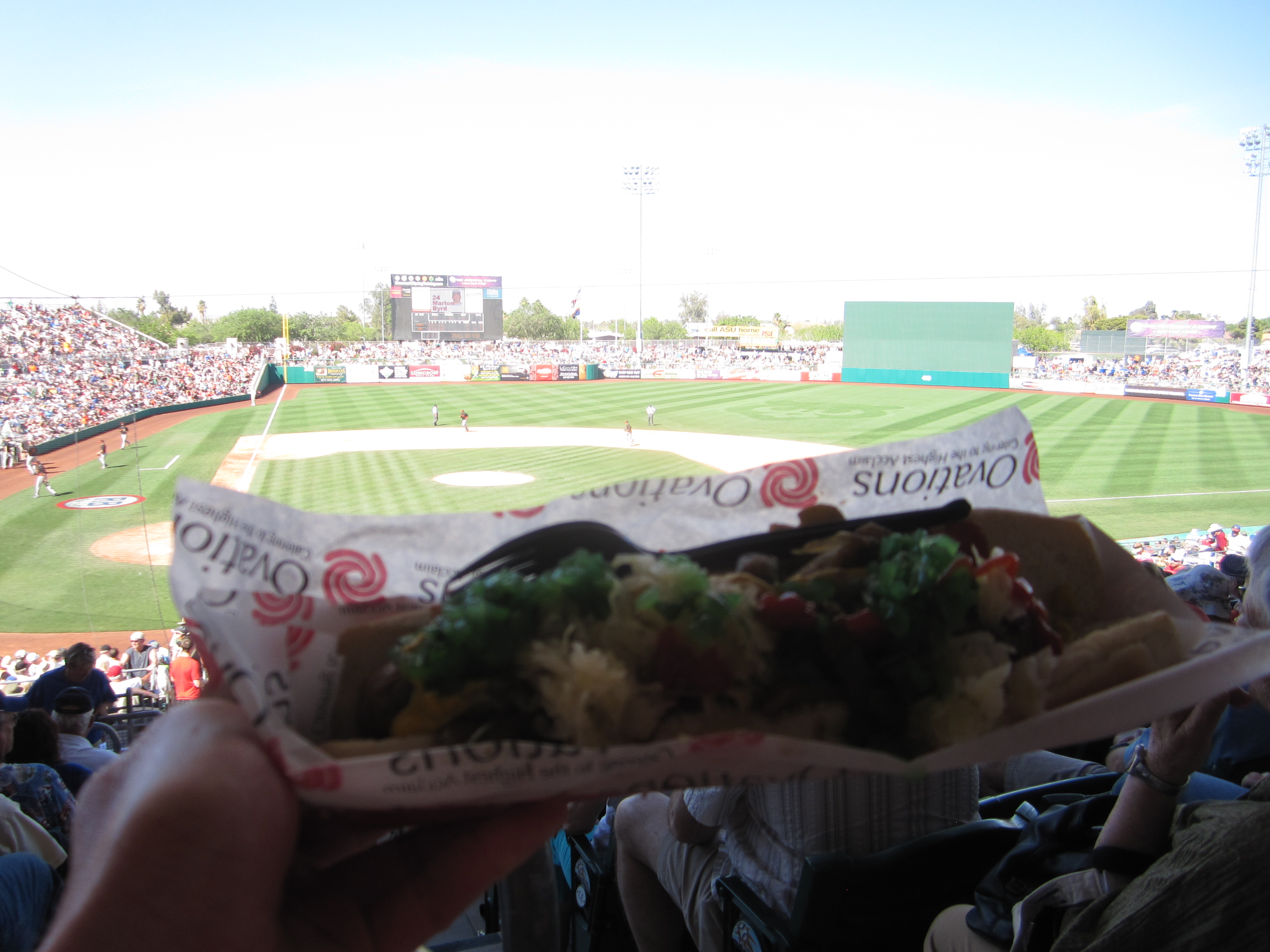
Sausage at Hoho Kam Park, Spring Training home of the Chicago Cubs
Yet there is always a time when you want to have a little sushi, some peanuts from outside the ballpark ($4 less outside the ballpark than inside in San Francisco), even a Mrs. Fields cookie and Dippin Dots, maybe a local salad, and then that Alaskan king crab to round out the meal touching all seven bases.
Ballpark food is quite fascinating, but really, at the end of the day, nothing can beat a hot dog (make sure it’s humanely raised meat), cracker jack (eh, not local or gourmet), and a beer (make it a craft brew!) with some baseball, even when the Sox are getting pasted 18-3.
A great “pizza issue” in yesterday’s New York Times Dining & Wine section, especially the article by Jeff Gordinier on anchovies.. I have for years advocated for poor, neglected anchovies and sardines to be respected again. They are certainly coming on in popularity. Still, too many family members and friends think of anchovies as the salt bombs in tins that are meant for sailors voyaging across the Seven Seas in the 1400’s. Sardines on pizza or sardines gently roasted in fig leaves…outstanding.
Gordan Ramsay is branching out from beyond England and the U.S. now…hello, Qatar! It sounds like Doha is really growing in advance of the 2018 World Cup with new buildings, stadiums, and a food scene boom too. I’ve been hearing first hand reports from a trusty confidant currently in Doha for the International TED Expo (rumor has it that José Andrés and Anthony Bourdain in fact are there).
Two interesting bits of analysis– Ramsey’s New York and Los Angeles outposts have not hardly been considered on the level that his London flagship is (one of two London Michelin 3 stars with Alain Ducasse). Secondly, it’s quite intriguing to see how the St. Regis is really trying to use celebrity chefs as a huge catch to bring people to their newest resorts and hotels. Last year they brought in Jean-Georges Vongerichten to be the consulting chef at the Princeville Resort’s new Kauai Grill when they took over the resort.




 Trev's Bistro